

On July 11 and 12, the premiere of the play UKRAINOMANIA took place in Lviv on the stage of the Zankovetska Theater. This large-scale project, dedicated to the writer Joseph Roth, brought together a team from Germany, Austria, and Ukraine, aiming to discuss war, Ukraine’s European roots, and art during wartime. We share how the performance was created.
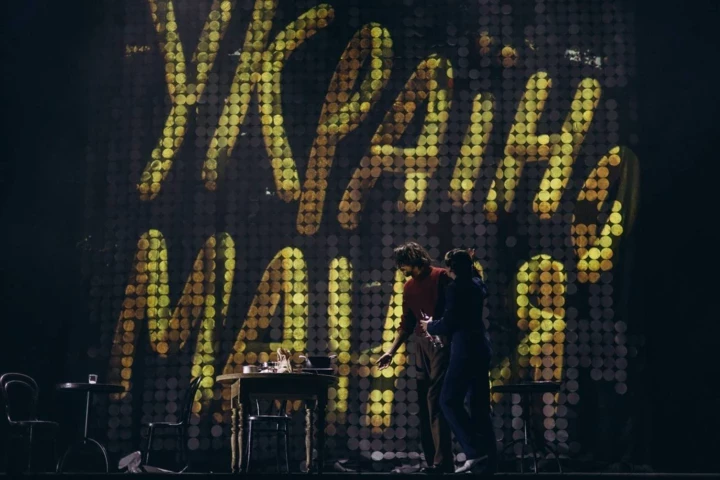
UKRAINOMANIA opens with a scene depicting a tour of Brody, a small town in the Lviv region. In 1894, Joseph Roth, one of the world’s most renowned German-language writers, was born here in a city then part of the Austro-Hungarian Empire. The tour is led by a real guide, Vasyl Strilchuk, director of the Brody Museum of Local History. He introduces the guests, portrayed by actors Solomiia Kyrylova, Ihor Bilyts, Yelyzaveta Tsylik, Stepan Hlova, and Oleksandra Bonkovska, to the “Bristol” hotel, which Roth featured in his works; to Zolotа Street, known for its jewelry stores that the writer frequented; to the gymnasium where he studied (now home to a monument to Roth); and to the cemetery where prominent figures are buried, such as relatives of Sigmund Freud. “So, was Freud also Ukrainian?” one of the tour guests aptly queries.
Advertising.

This brief scene of the Brody tour is highly revealing: it underscores how little we know about ourselves and how little the world knows about us. It was precisely this gap that the project UKRAINOMANIA, uniting three countries, two theaters—the Vienna Volkstheater and the Lviv Zankovetska Theater—and about a dozen engaged individuals—began addressing three years ago. Leading the team is 44-year-old Jan Christoph Gockel, director at the Munich Kammerspiele, whose interest in Ukraine extends beyond news headlines. Jan first visited Ukraine in 2019 to see friends and, in 2022, “felt the need to talk about what is happening in Ukraine in Germany,” he admits during our meeting in Lviv. This is his fifth trip to Lviv; he shelters with Ukrainians and endures air raids, and according to the play’s dramaturg, Oksana Lemishka, he “brilliantly grasps the situation in Ukraine.” In 2023, Gockel directed Natalka Vorozhbyt’s play “Green Corridors” at the Munich Kammerspiele—a poignant and tragicomic story about Ukrainian refugees in Germany, commissioned by the Munich theater. That same year, he visited Kyiv and traveled to the de-occupied towns of Bucha, Irpin, and Borodianka. Profoundly affected by what he saw, he then penned a lengthy report on Ukrainian culture during wartime for a German publication. “As an artist, I feel I want to be where the most important things are happening. The most important things are happening here now,” Jan states simply.

In 2024, Jan was invited to Lviv by the artistic director of the Zankovetska Theater, Maksym Holenko, and producer Alina Rashko. Ultimately, his encounters with the theater team and Lviv residents inspired Jan to create a performance centered on Joseph Roth—an undisputed star of German-language literature, author of novels such as “Hotel Savoy,” “Rebellion,” and “The Radetzky March,” a veteran of World War I, and a brilliant reporter. The life of Roth, a charismatic artist and adventurer portrayed by German actor Bernardo Arias Porras, is worthy not just of a play but of a blockbuster film. At 19, Roth, who never knew his father and whose mother died of cancer in 1922, left Brody. He studied at Lviv and Vienna universities, wrote for leading European publications, lived in Berlin, Vienna, and Paris, was a “patron saint of hotels” because he was constantly on the move; he married a woman who developed schizophrenia, fled Nazi Germany in 1933 after his books were banned, struggled with alcohol, had tumultuous relationships with women, and ultimately died in Paris in 1939 after a four-day binge. However, there’s another crucial reason why this play, whose initial version premiered in January 2026 at the Vienna Volkstheater, is dedicated to Joseph Roth and remains relevant today. In his novels and reports, Roth masterfully depicted the multicultural world of Galicia, and his work serves as a bridge between the cultural heritage of Lviv and Galicia and the intellectual milieu of Vienna.
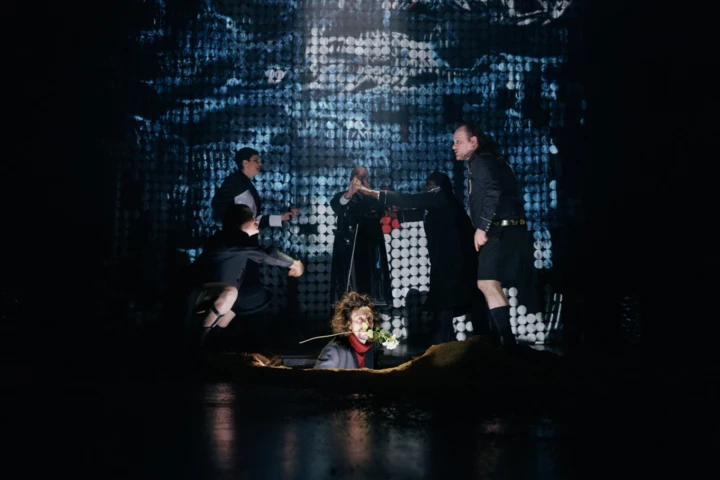
“Before coming to Roth, there was Lviv first,” the director shares. “Two years ago, I came here to understand the city, the theater, Galicia. Only then did I learn that Joseph Roth lived here, born on Ukrainian soil.” In 2024, Gockel presented a sketch titled “Who the Hell is Joseph Roth?” on the stage of the Zankovetska Theater, which marked the beginning of the “Ukrainomania” project.
While working on the sketch, the director, along with actors and the team, traveled to Brody to explore the town. There, they met individuals who could help understand Roth, such as literary critic and psychoanalyst Yurko Prokhasko, a translator and researcher of Roth’s work. The encounter and an almost existential conversation between actor Bernardo Arias Porras, who plays Roth, and Prokhasko were filmed and shown in the play, proving pivotal in comprehending Roth’s character: “Did I see a way out?…” the actor asks Prokhasko. “No, exits are not your nature,” the writer replies. “Neither from war nor from love.”
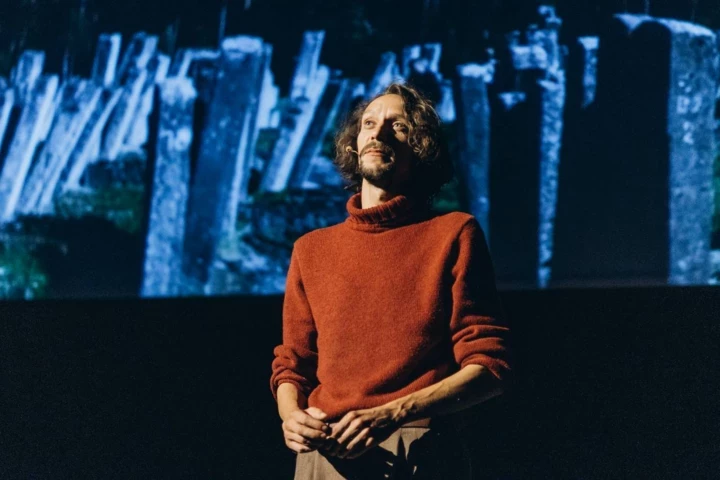
“When I was in Brody and Lviv, what touched me most was how Ukrainians connect Roth’s biography with the current situation,” Jan explains. “Roth lived during a time of immense change. He was a refugee. He was a soldier, a veteran, an artist persecuted by fascists. He fled from Berlin, from Vienna, found refuge in Paris. Ultimately, he spent his life fleeing, and I believe this makes him an ideal hero for our times.”
Actress Solomiia Kyrylova, who embodies the role of a “Shakespearean gravedigger” in the play, attempting unsuccessfully to bury Roth alongside her partner (Ihor Bilyts), as well as several other colorful characters, shares that during the casting in Lviv, the German director was searching not for actors but for “characters.” “The casting began with questions about why theater is needed during wartime,” Solomiia recalls. “We talked about war, art, and personal experiences.” The actress remembers meeting Jan when she was pregnant, the first sketch of the play in Lviv was staged when her son was only two months old, and she traveled to rehearsals in Vienna (Kyrylova is the only Ukrainian actress performing in both Vienna and Lviv) when her son was just one year old. She describes the “creative process as dynamic and transformative.”
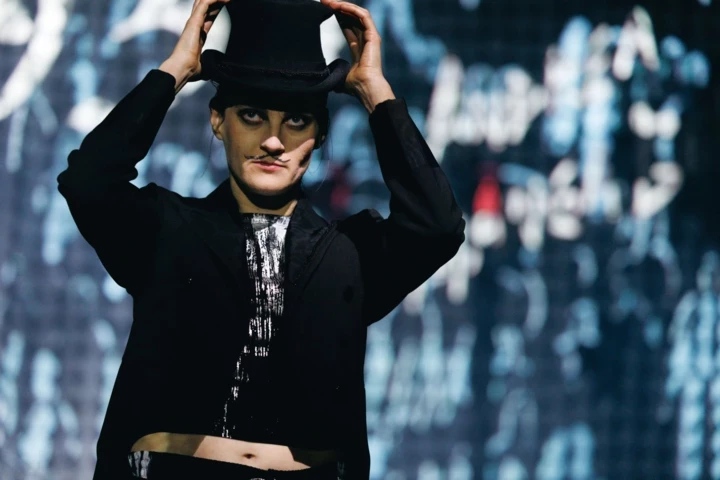
Why is the project titled “Ukrainomania”? It shares its name with an essay by Roth, published in 1926—a witty and observant account by the writer of how, in the early 20th century, the Ukrainian question suddenly found itself at the center of European politics and intellectual discourse. Roth describes a wave of fashion for Ukraine and Ukrainian things, particularly in Berlin, following Ukraine’s brief period of independence.
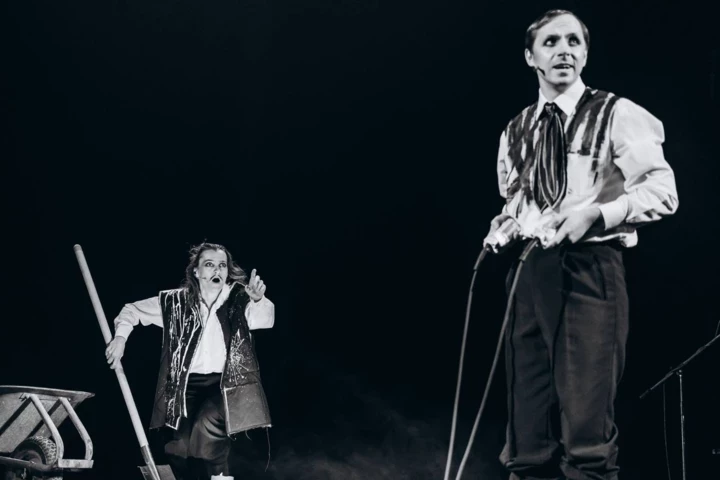
In the play, stories from Roth’s life—about his travels, parties, relationships with women, authorities (monarchists, socialists), and religion—are interwoven with the personal narratives of the actors concerning contemporary Ukraine, which in turn intertwine with Roth’s own life story. For instance, while performing in Vienna, actress Solomiia Kyrylova recounts an experience of surviving a shelling of Lviv that damaged her home. In the Lviv version of “Ukrainomania,” Solomiia recalls her residency in Berlin in 2022. “I wanted to have a reminder of Ukraine with me, so I placed a small flag sticker under my phone case. In the subway, when people saw it, their reactions were mixed; some moved away entirely. Later, I decided to be more strategic and approach it indirectly—I placed small printed photos of Olha Kobylianska and Lesya Ukrainka there,” the actress shares from the stage. The reaction to the photos was entirely different: Germans approached Solomiia, curiously asking who these beautiful women were, if they were her relatives. “They are relatives of all Ukrainians,” Kyrylova replied. The actress finds it symbolic that 100 years after Roth, living in Berlin at the time, wrote his “Ukrainomania,” she experienced a similar level of attention in Berlin.
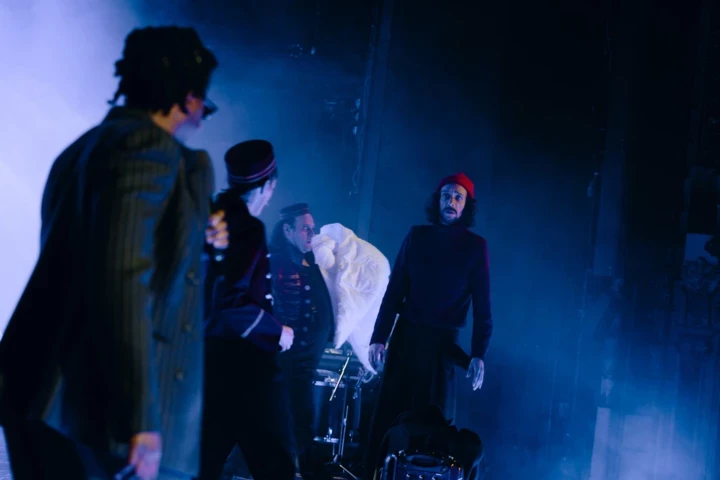
“When Jan creates a play, he manages to make the audience cry, laugh, and then reflect,” says dramaturg Oksana Lemishka, who worked on the script alongside German playwrights Klaus Philipp and Tobias Schuster. “In ‘Ukrainomania,’ he portrays the absurdity of war but also the possibility of overcoming it. Ultimately, it’s a play about searching for strength and light.”
In the upcoming season, the play UKRAINOMANIA will be staged in two cities—Vienna and Lviv. While one of the project’s primary objectives in the European context is to present Ukraine as a country of European values—modern, artistic, and free—through the lens of Joseph Roth, defining the play’s place within Ukraine is a far more challenging task. “I wanted to find words and images through which one can speak about difficult times,” says the director, and this is undoubtedly an ongoing exploration.